+49 (0)89 70065020


Living space
How to correctly calculate living space
Living space plays an important role in determining real estate prices and rent levels. However, not every square meter automatically counts as living space. In practice, the Living Space Ordinance (WoFlV) is most frequently applied when calculating living space. The determination of living space affects the billing of operating costs, the determination of the local comparative rent, or proceedings regarding excessive rent. Therefore, landlords should also familiarize themselves with the concept of living space.
Methods for calculating living space
The determination of the living space can be based on various regulations and rulebooks take place. Mostly, the Floor Space Ordinance used from November 23, 2003. It is a well-established regulation and is mandatory for publicly subsidized housing. The Living Space Ordinance must also be used to calculate the living space for tax-privileged housing or housing subject to non-profit housing law (§ 82 II WoBauG).
The Second Regulation on Calculations (II. BV) was valid for the calculation of living space from November 1, 1957 to the end of 2003. This statutory ordinance governs the profitability calculation for living space. Living spaces calculated according to this regulation until December 31, 2003, retain their validity.
Furthermore, the Floor space calculation according to DIN 277 be carried out. It is worth knowing that the term living space does not appear in DIN 277. DIN 277 defines the net floor area (NFA). It consists of usable area (UA), technical area (TA), and circulation area (CA). This standard is listed in the construction industry under the designation floor areas and cubic capacities.
Finally, it is possible to Living space and usable floor area according to DIN 283 to be calculated. This standardization has established itself as a recognized rule of technology. When calculating customary local comparable rents, it is permissible to use DIN 283. However, it is necessary that both contracting parties accept this set of rules as the basis for calculating the living space.
The choice of the calculation method has an impact on the determination of living space. Subsequently, the application of the Living Space Ordinance is explained in more detail because it has become established in practice and is mandatory for publicly subsidized apartments.
Which rooms are included in the living space and which are not?
The Living Space Regulation defines the floor areas and determines which rooms are counted toward the living space (§ 2 WoFIV). Measured in an apartment or house all rooms including kitchen and hallway. Furthermore, the living space includes Conservatories, swimming pools and similar rooms that enclosed on all sides are. Balconies, loggias, roof gardens, and terraces are also part of the living space., if they belong exclusively to the apartment or house. Shared terraces therefore must not be included in the living area.
The areas of door and window frames, built-in furniture, as well as stoves and bathtubs, are included in the calculation.
According to the Ordinance on Floor Space, storage rooms outside the apartment as well as cellars, laundry rooms, drying rooms, boiler rooms, attic spaces, commercial spaces, or garages are not counted towards the living space.
All rooms that do not meet the requirements of building regulations are also not part of the living space.
The height of the rooms is crucial
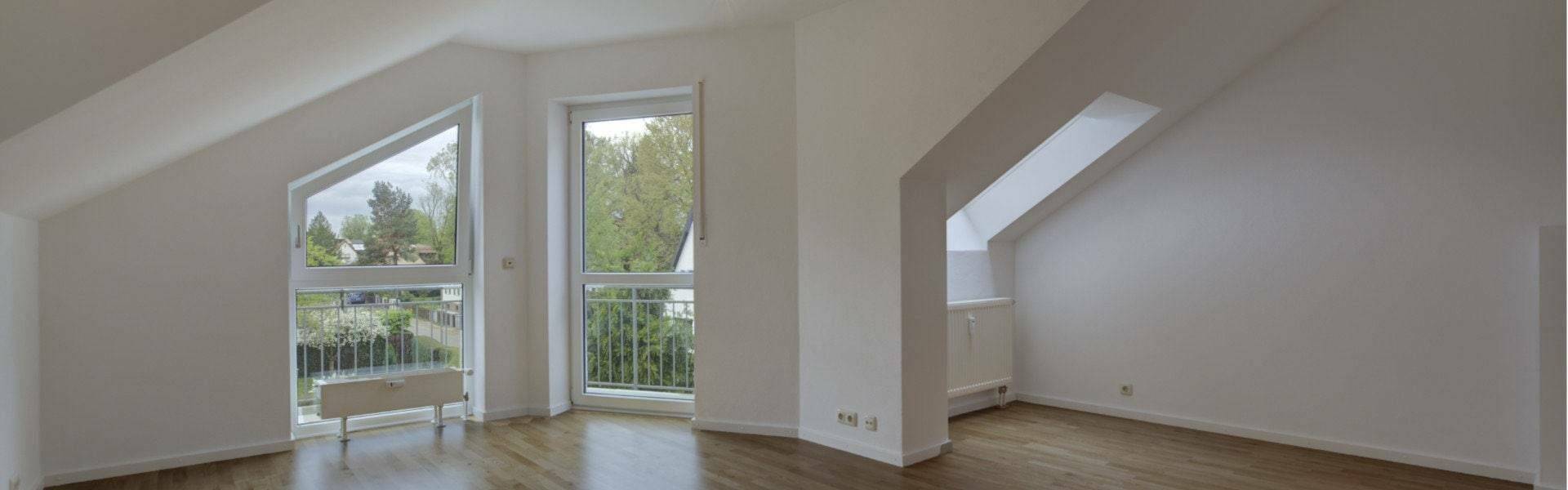
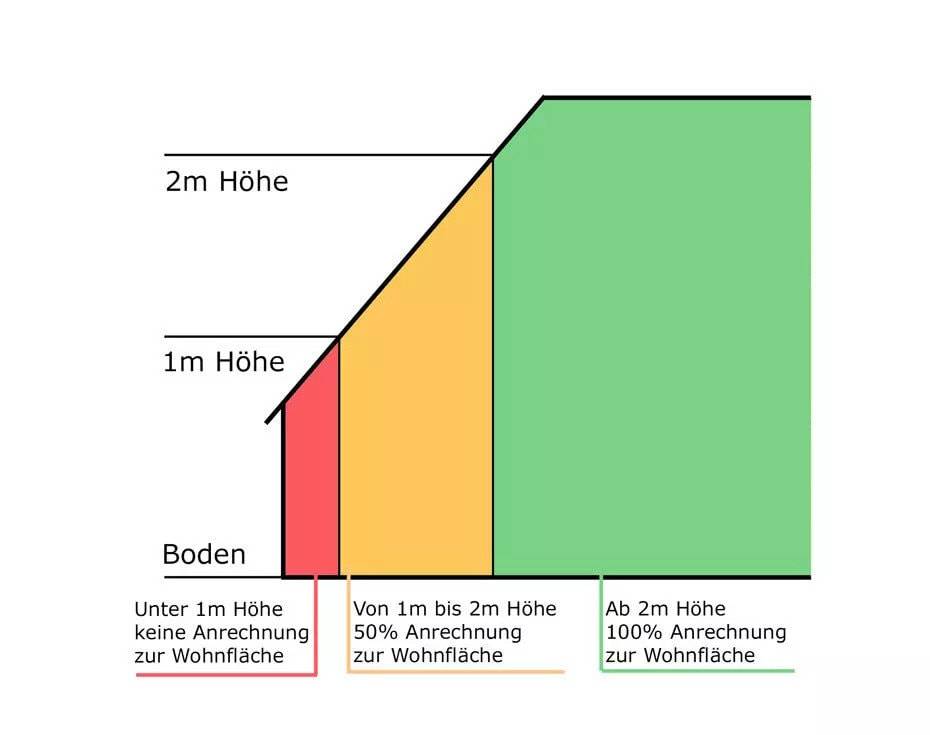
For the calculation of the living space, the room height plays a particularly decisive role. In attic apartments, Areas under sloped ceilings with a headroom of up to one meter are not counted toward the living space at all. Area under a slope from one meter up to two meters can only be calculated by half be. The same applies to rooms that are less than two meters high, such as attic rooms. Rooms and parts of rooms that have a height of at least two meters or more are fully counted towards the living space. If there are stairs within the apartment, areas beneath stairs are calculated according to the same principle as sloped ceilings.
Calculation of balconies etc.
Often apartments and houses are equipped with balconies, terraces, roof gardens, conservatories, and swimming pools, which increase the value of a property. The question is to what extent they can be included in the living space calculation. Unheated conservatories and swimming pools can only be counted with half of their area. Balconies, roof gardens, and terraces are counted at one quarter or at most one half of their area, depending on their size, orientation, and location.
Can hobby rooms be counted as living space?
Hobby rooms are generally located in the basement. If the room is fully usable as living space and can be heated, it may be fully included in the living area calculation. This was confirmed by the Federal Court of Justice (BGH, judgment of May 23, 2007, VIII ZR 231/06). It is important that the hobby room is located within the apartment.
The consequences of determining living space
The square footage has far-reaching consequences. The size of the property is an important criterion as part of the Real estate appraisal. Both in the capitalized earnings method and the comparable sales method, the living area is absolutely necessary so that the market value or purchase price can be determined. If a reliable calculation of the living area, for example by an architect, is not available, a living area measurement must be carried out. It is advisable to review the plans with the living area specifications. Especially with Real Estate Sales the living area is not only necessary for the exposé and advertising, but banks also require this square footage as a basis for calculating the lending value. In order for the financing to be approved, credit institutions generally demand a comprehensible calculation of the living space.
The living space also plays a far-reaching role for tenants and landlords, because the rent or a Rent increase is derived from the actual living space. Especially in connection with the rent control cap and apartment size, conflicts and disputes can arise in this regard.
Both in Rental as well as in real estate sales, the area measurements are important. Therefore, they should be carefully checked before marketing to avoid later discrepancies. In the case of renting, incorrect living space information can under certain circumstances lead to rent reduction lead. Deviations within certain limits are permissible, but not desirable.
The living space can, but does not have to be, stated in the tenant agreement. If the living space was agreed upon in the rental agreement, this information is considered proof until inaccuracy is proven. If landlords agree on the exact area in the rental agreement, this constitutes a specification of quality upon which the tenant can rely. If a living space deviation of more than 10 percent below the area agreed upon in the lease agreement is established, then the tenant can demand a rent reduction. This principle also applies to the Billing of utility costs / operating costs applicable.
It is therefore important to ensure that you work with the correct floor space measurements before the renting or selling process.
We verify the living space for rentals and sales
If you help us with the Sale or with the Rental your property, we check the living space and create a living space calculation. You can expect competent and professional advice tailored to your individual situation. We take care of all the details so that you can sell or rent your property quickly and stress-free. We look forward to hearing from you. Do not hesitate to contact us contact.
Share


Download as PDF

Print page